Why do you wear some socks all day, while others you want to take off after an hour??

Why do you wear some socks all day, while others you want to take off after an hour??
When buying socks, hardly anyone thinks about the material.The decision is usually quick: the right size, a reasonable price—we add it to the cart.It's not until you've been wearing it for a few hours that you realize something's wrong.Socks start to feel tight, get hot, or feel damp—a sensation that's hard to shake off even after taking off your shoes.
This is the moment when many people start to think, “That’s just how it is with socks.”.But that's not entirely true.
A short anecdote that illustrates a shift in perspective well
To illustrate this better, let's imagine a completely ordinary situation.Someone is scrolling through their phone in the evening, without any particular purpose, before going to sleep.Amid the daily content, she comes across an article—not an ad or a shopping guide, but a laid-back piece about cotton and its role in clothing worn directly against the skin.
The author points out something that people rarely think about: that for years, cotton has been the material of choice in situations where it comes into contact with the skin for many hours at a time.Not because it was flawless, but because it was the least likely to cause discomfort during prolonged contact with the skin.
At one point, a line is spoken that sticks in your mind:
Less than 70% cotton is a compromise, not quality.
That doesn't sound like a slogan.It sounds like something no one has ever said outright before.And that's enough to see the issue in a different light.
The next day, without any grand declarations or revolutions, someone peeks into the sock drawer out of curiosity.First pair — 20% cotton.Second — 40%.The third group—the “better” ones, bought at one point with the idea that they’d be something of higher quality—60%.
Until now, they were just ordinary socks.Now, all of a sudden, they all fall into one category: compromise.
After work, it's time to put it into practice.The first store—a shelf full of socks, but the mix was surprisingly familiar: 50%, 60%.The second store—it's better; one pair is 80% off.The seller says it's a very good selection.
And maybe he's right.It's just that one sentence is still stuck in my head.If 60% is the standard and 80% is “better,” then where does quality begin??And why is it so hard to find socks that don't make compromises??
At this point, the way we view socks changes.They're no longer just impulse buys tossed into the shopping cart.They become a factor that truly influences how the day ends.It's not about luxury or fashion.It's something you wear for many hours, which either helps or gets in the way.
And suddenly, the question is no longer “Is cotton important?” but rather: Why have we accepted compromise as the standard for so many years?
What does this mean in practice?
If most of the socks available contain between 50 and 70 percent cotton, that means this compromise has come to be seen as the norm over the years.Not because it's the best, but because it's the most readily available.
However, socks aren't just a "temporary" product.We wear them for hours on end, day after day, often under the same conditions.If we make concessions as early as the design stage, the consequences aren't apparent in the store, but only after a few hours of use.
That is why the difference between 60%, 80%, and 100% cotton is not abstract.It's not listed on the label.It happens in the evening when we take off our shoes.
Where are Steven's socks in all this?
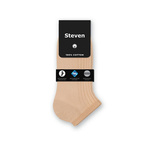
Steven brand socks show up exactly where compromise ends.They aren't trying to prove that they're "revolutionary" or "the best on the market".They simply and consistently adhere to one principle: a very high cotton content—no half-measures.
This is for those who, after reading a story like this, look into their own drawer and start calculating percentages.And they come to the conclusion that since something is in direct contact with the skin for over a dozen hours a day, maybe it’s worth stopping treating it as an impulse buy.
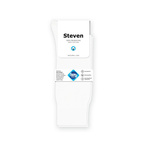
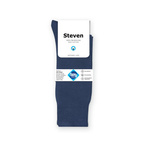
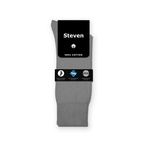
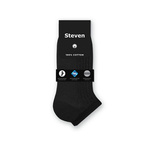
If, after reading this article, you'd like to see what a day in 100% cotton socks is like, below are a few examples available in our store.